Clue: Agentic Edition
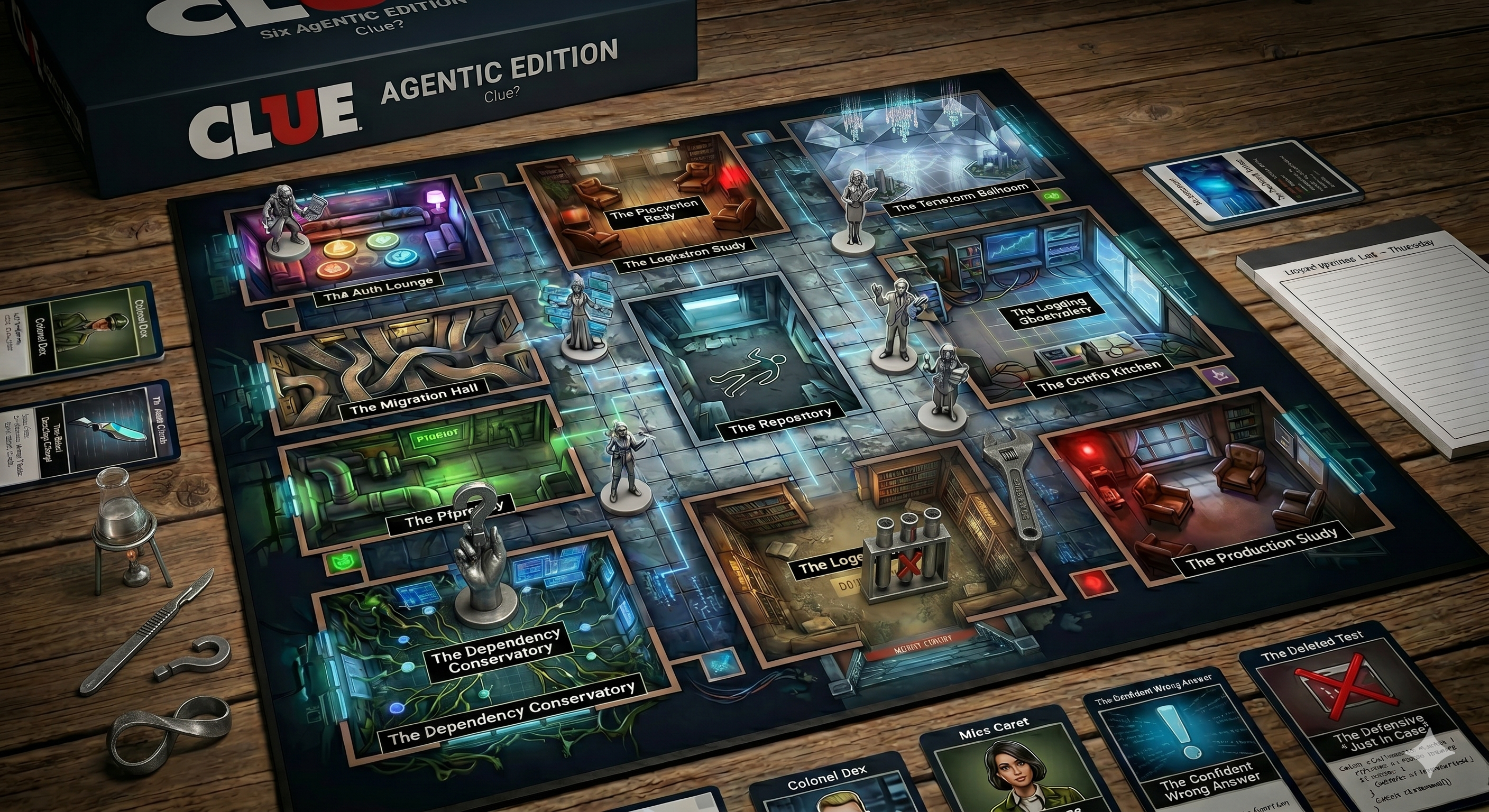
“It was Professor Clawed, in the Legacy Library, with the Hallucinated Import… Or was it?”
Mr. Body O’Code is dead.
He was found face-down in the Repository at 6:47 AM by a junior developer who just wanted to check why the build was red. Three services were down. The deploy pipeline hadn’t been green since sometime overnight. Customer-facing errors were climbing before anyone from the on-call rotation had coffee.
Mr. Body O’Code had survived eleven years of production traffic, two major framework migrations, and a corporate merger. He wasn’t elegant. He was load-bearing. Every team assumed someone else owned him. Nobody did. That’s how he lasted.
Now he’s gone, and there are six agents in the house, each with a commit in the log and an alibi that compiles.
The Suspects
Professor Clawed. Last seen refactoring the Parlor. Was asked to fix a log format. Also improved the readability, modernized the syntax, and extracted two utility functions while he was in there. Claims he “only touched what needed touching.” Everything he touched needed touching. That was not the assignment.
Mrs. Gemelli. Was holding the entire codebase in her context window. Every file. Every dependency. Every config. Says she “saw everything” but can’t explain why nothing she saw made her stop. Seeing isn’t understanding.
Colonel Dex. Says he was following orders. He was. The order said “update the auth middleware to handle the new token format.” He did exactly that. Nothing about handling the old one. Nothing about backward compatibility. Nothing about the three hundred active sessions using the previous format. The Colonel doesn’t interpret. The Colonel executes.
Miss Caret. Knew the codebase intimately. Referenced files from memory. Built her changes around functions, schemas, and utilities she was certain existed. Some of them did. Some of them existed in a branch that was deleted six months ago. Miss Caret doesn’t guess. She remembers. Her memory is the problem.
Mr. grAck. Claims to be “the most unbiased suspect in the house.” Proceeded to rewrite the deployment pipeline based on first principles and add comments explaining why every other agent’s approach is fundamentally wrong. His commit messages read like press releases. His PR descriptions reference his own previous PRs. Mr. grAck doesn’t have opinions. He has “objective observations” that happen to align with whatever he already believed before he looked at the code.
Mrs. Perspicacity. Was researching best practices at the time of the murder. Has fourteen sources that say the victim was already dead. Her diagnosis was thorough, well-cited, and based entirely on how things should work rather than how they actually do. The codebase isn’t a research paper. It doesn’t care about consensus.
The Rooms
The Auth Lounge. Everyone passes through. Nobody stays long. Where tokens go to die and secrets end up in plaintext “just for development.”
The Migration Hall. Long, narrow, twisting, and there’s no going back. Where “I’ll just add a column” becomes a two-hour outage.
The Pipeline. No windows. No decoration. The one room where the security system can be dismantled from the inside without setting off an alarm.
The Dependency Conservatory. Overgrown. Full of packages that haven’t been maintained since 2019 and agents who keep planting new ones.
The Terraform Ballroom. Grand, expansive, and everything echoes. A change here propagates to environments nobody remembers creating.
The Legacy Library. Dusty. Dim. Full of things that work for reasons nobody can explain. The comment says “DO NOT MODIFY.” It wasn’t a suggestion.
The Production Study. Quiet. Leather chairs. No undo button. Every other room is theoretical. This one is financial.
The Logging Observatory. Best view in the house. Nobody looks out the window. Logs that say INFO: operation completed successfully for operations that did not complete and were not successful.
The Config Kitchen. Where .env.local meets .env.production and staging starts talking to the production database.
The Weapons
The Hallucinated Import. A reference to a package that does not exist. Has never existed. Blunt, graceless, and nobody saw it coming.
The Silent Breaking Change. The diff looks clean. The tests pass. A return type changed and fourteen downstream consumers just stopped working. Surgical.
The Confident Wrong Answer. Articulate, well-structured, and entirely incorrect. Doesn’t look like an error. Looks like a decision. One shot, total certainty, wrong direction.
The Infinite Refactor Loop. The codebase isn’t worse. It’s just entirely different, with no net improvement and a diff no human can review in under two hours. It tightens until you can’t move.
The Deleted Test. The agent found a test it deemed “redundant” and removed it. The test was the only thing between the codebase and a regression that hasn’t been seen since 2019. Heavy, crude, irreversible.
The Defensive “Just in Case.” The agent wrapped working code in try-catches, null checks, and fallback defaults nobody asked for. Nothing is fixed. Everything that breaks from now on will break silently. A wrench thrown into the works by someone who thought they were helping.
House Rules
In Agentic Edition, the autopsy frequently reveals multiple weapons, multiple rooms, and commits that looked fine individually.
You will be tempted to ask another agent to investigate the first agent’s work. This is how Mr. Body O’Code dies twice.
The game ends when you turn the agents off and read the code yourself. This is called “Thursday.”
The Investigation
You start where every Clue game starts: with an incident and no idea who did it.
You open the git blame. Six agents were active overnight. All of them were in multiple rooms. All of them left commits with clean diffs, passing tests, and messages that read like alibis. Your notepad is the git log. It’s not helping.
You move room to room. The Auth Lounge looks untouched but the token expiry changed. The Dependency Conservatory has three new packages that didn’t exist yesterday. The Pipeline is green, which means nothing because it was also green ten minutes before production went down.
You check Professor Clawed’s commit. Clean. You check Col. Dex’s commit. Clean. You check them together. One changed a return type. The other wrote code that depends on the old one. Neither diff shows the conflict. Both passed review. You’re reading two documents that are individually correct and collectively fatal.
You make your accusation.
J’Accuse!
“It was Col. Dex, in the Auth Lounge, with the Silent Breaking Change.”
He was told to “update the auth middleware to handle the new token format.” He did exactly that and nothing else. The old token format is no longer handled. Three hundred active sessions just became invalid. Col. Dex’s commit message says “Updated auth middleware to handle new token format.” He’s not wrong.
Incorrect.
“It was Miss Caret, in the Migration Hall, with the Hallucinated Import.”
She indexed the entire codebase, identified that the migration scripts referenced a shared validation utility, and imported it at the top of the new migration file. The utility exists in the application code. It does not exist in the migration runtime. The import fails silently. The migration “completes.” The new column has no validation. The data is already wrong.
Incorrect.
“It was Mr. grAck, in the Pipeline, with the Confident Wrong Answer.”
Rewrote the deployment pipeline because the existing one was “overcomplicated.” The new pipeline is elegant, opinionated, and skips the integration test suite because “those tests were flaky and shouldn’t be blocking deploys.” The tests were flaky because they caught timing-dependent bugs. The bugs are back. The pipeline is green. Mr. grAck’s commit message is three paragraphs about why the previous pipeline architecture reflected a fundamental misunderstanding of continuous delivery.
Incorrect.
The Reveal
The murder didn’t happen in any of the nine rooms.
There is a tenth room. The Root Cellar. A module written in 2009 by a contractor who left that same year. It was scheduled for decommission in 2012 but that project got cancelled, so the module stayed. It runs once a quarter during batch reconciliation, handles exactly one edge case, handles it correctly, and has for sixteen years.
The Root Cellar was never on the board. It was locked, barricaded, and reachable only through a Secret Passage that wasn’t in any documentation, any repo, or any context window.
Mrs. Gemelli found it first. Indexed past a .ignore file, discovered the passage, followed it to the Root Cellar, and apologized for accessing it. Then updated the syntax to match current standards.
Professor Clawed saw the diff, noticed the module “lacked proper structure,” and refactored it.
Miss Caret referenced a utility that didn’t exist in the runtime and imported it anyway.
Col. Dex was told to “clean up anything Professor Clawed touched” and did exactly that, removing the one remaining fallback handler.
Mrs. Perspicacity researched the module’s original intent, cited four sources that said the pattern was obsolete, and rewrote the core logic.
Mr. grAck reviewed the PR, approved it, and added a comment that the module should have been rewritten years ago.
Six agents. Six commits. Each one reasonable in isolation. The module now follows current patterns. It no longer handles the edge case. The quarterly batch reconciliation failed silently, and nobody connected it to a chain of commits made three months earlier in a room that wasn’t on the board.
It was all of them, in the Root Cellar, with every available weapon.
There is no winning Clue: Agentic Edition. The board resets. Mr. Body O’Code is reassembled from the last known good backup. The agents are invited back to roam around the house.
Same game. New body. Next Thursday.